Cuckfield’s D-Day approaches but there is still time to join David v Goliath battle and prevent proposed development catastrophe
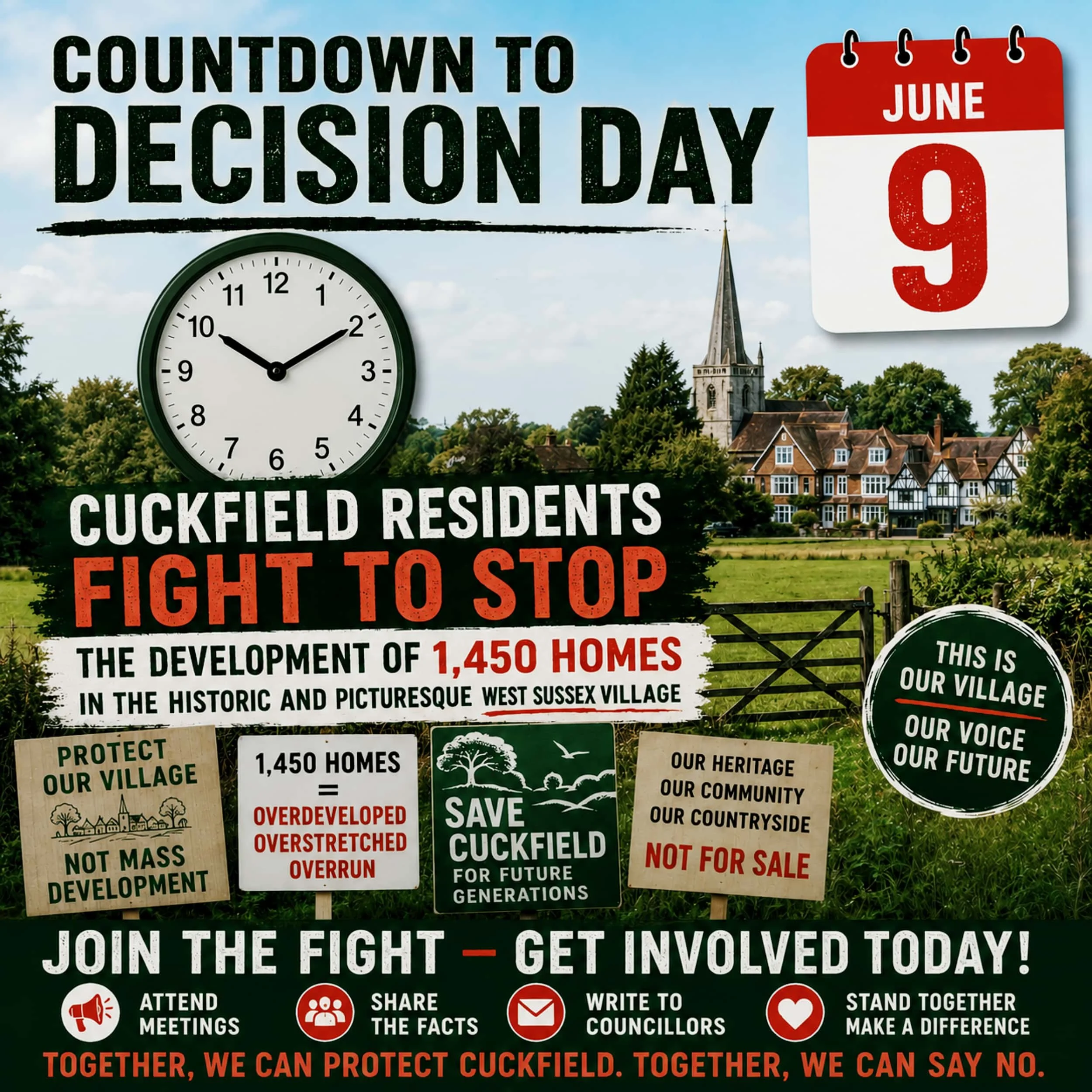
Decision day is fast approaching. One destined to have a fundamental affect on the future of Cuckfield and its residents. Is the character of the village to remain, or is the go-ahead to be given for a huge housing development, changing this area forever?
The Cuckfield Society is asking villagers to stand up for their community in opposing the proposal to build 1,450 houses on the Ansty Farm site, dubbed Cuck-Stye, at the edge of the village. A proposal which was rejected by Mid Sussex Council last October, but is subject of Appeal by developer Fairfax Aquisitions.
June 9 is the deadline when the crucial decision will be made. Residents attending The Cuckfield Society’s annual general meeting at Whitemans Green Sports Club this week, were asked to make their voices heard by joining a public protest outside the Council’s Haywards Heath HQ on the day. Keep following our news page for more information. A similar protest back in October was effective. As was the presence of residents in the public gallery to demonstrate the level of concern. The protest also attracted local TV coverage.
Earlier this year The Cuckfield Society appointed a barrister to navigate through the legal complexities of the Appeal, funded by supportive and much appreciated residents who continue to donate through this website. Fighting developer Fairfax is an expensive business. Donations are still needed to cover the increased costs associated with reviewing Fairfax’s late-stage plan changes in this David versus Goliath battle.
Meanwhile, a new District Plan is due to be adopted by the Council towards the end of the year. Giles King, chairman of The Cuckfield Society, told the meeting at Whitemans Green: “We're going to find out in a week's time, on the 15th of May, whether the Ansty Farm site is going to be on a list that could be added to the District Plan to meet the additional housing requirement that inspectors insisted the Council allowed.

Giles King, chairman of The Cuckfield Society
“The Council's got to find room for something like 3,000 to 3,500 additional houses over and above those that have been allocated at the moment. So they're going through a process of identifying potential extra sites.
“Ansty Farm site may or may not be on that long list. My guess is that it will be. But don't panic if it is. Between the 15th of May and around September the Council will be deciding which of the sites on that long list should actually be allocated.
“By that date, of course, we will know the outcome of the appeal. If it goes in our favour, it is highly unlikely that the Council will then decide to allocate that site. That is because the planning inspector will in effect determine that it's not a sustainable location to put fourteen-and-half-thousand houses.”

Planning applications and appeals are complicated and often confusing processes, so with this in mind we thought we would share a Q&A from the Society’s AGM to help clarify the situation Cuckfield is facing. If you wish to support the cause, use the quick and easy donation form at the top or bottom of this page.
What’s happening and why it matters
Q: If the Appeal was won last October, how can Mid Sussex Council take a different position now?
A: Planning decisions are not purely objective. They often involve interpretation. While policies exist, different arguments can be prioritised depending on the case being made. In practice, decision-makers can start with a preferred outcome and build a policy case around it.
In this instance, although the previous appeal was successful, a new planning officer is now leading the case, and the Council is entitled to present a different balance of arguments at a new appeal.
Q: What were the main reasons for the original application being refused?
A:The key reasons were:
Harm to the surrounding landscape
Negative impact on the setting of the High Weald National Landscape
These remain the central arguments being defended at the current appeal, supported by expert evidence from both the Council and parish representatives.
Q: Are there any new arguments being introduced?
A: Yes. In addition to the original concerns, a further argument is being made:
The site is too car dependent and not sustainable as a standalone community
This point wasn’t part of the original decision but is now being supported with additional expert input.
Q: Has the council changed its position on housing supply?
A: Interestingly, yes. Previously, the council supported the development partly due to housing supply needs. Now, they are arguing that the site wouldn’t deliver homes quickly enough (with development unlikely before 2032), making it less effective in addressing housing shortages.
Q: Can the inspector suggest a smaller development instead?
A: No. The inspector will either approve or reject the proposal as submitted. They cannot redesign it or propose a reduced number of homes. However, there is growing recognition that smaller sites are often easier and quicker to deliver than large-scale developments.
Q: Why would development take so long to start?
A: Several factors contribute to delays:
Local wastewater infrastructure is already over capacity and requires upgrades
Transport improvements would need to be implemented first
The developer, Fairfax, would likely sell the site on after securing permission
Detailed (reserved matters) planning approval would still be required after outline approval
All of this means construction is unlikely to begin for many years.
Q: What is “outline planning permission”?
A: Outline planning permission establishes whether a site can be developed in principle. If granted, the developer must still return with detailed proposals (known as reserved matters), covering layout, design, number of homes, and infrastructure. This stage can take several more years.
Q: Does planning permission guarantee homes will be built?
A: No. Planning permission significantly increases the value of land, making it an investment asset. Developers may choose to:
Sell the land
Delay construction
Use it for financial leverage
In fact, there are over a million homes with planning permission in the UK that have not been built.
Q: What is the long-term concern for the area?
A: There is concern about cumulative development over time. While individual projects may seem manageable, together they risk:
Gradually merging towns and villages
Eroding countryside and landscape character
Creating long-term urban sprawl
This highlights the importance of strategic, long-term planning rather than short-term decisions.
Q: What happens next?
A: The appeal will be decided based on:
The strength of planning arguments
Expert evidence presented
Interpretation of policy
A planning inspector will review all submissions and issue a final decision on June 9.