CUCK-STYE for and against: three-week hearing over as village fight against appeal to U-turn original ‘no’ verdict now rests in Westminster
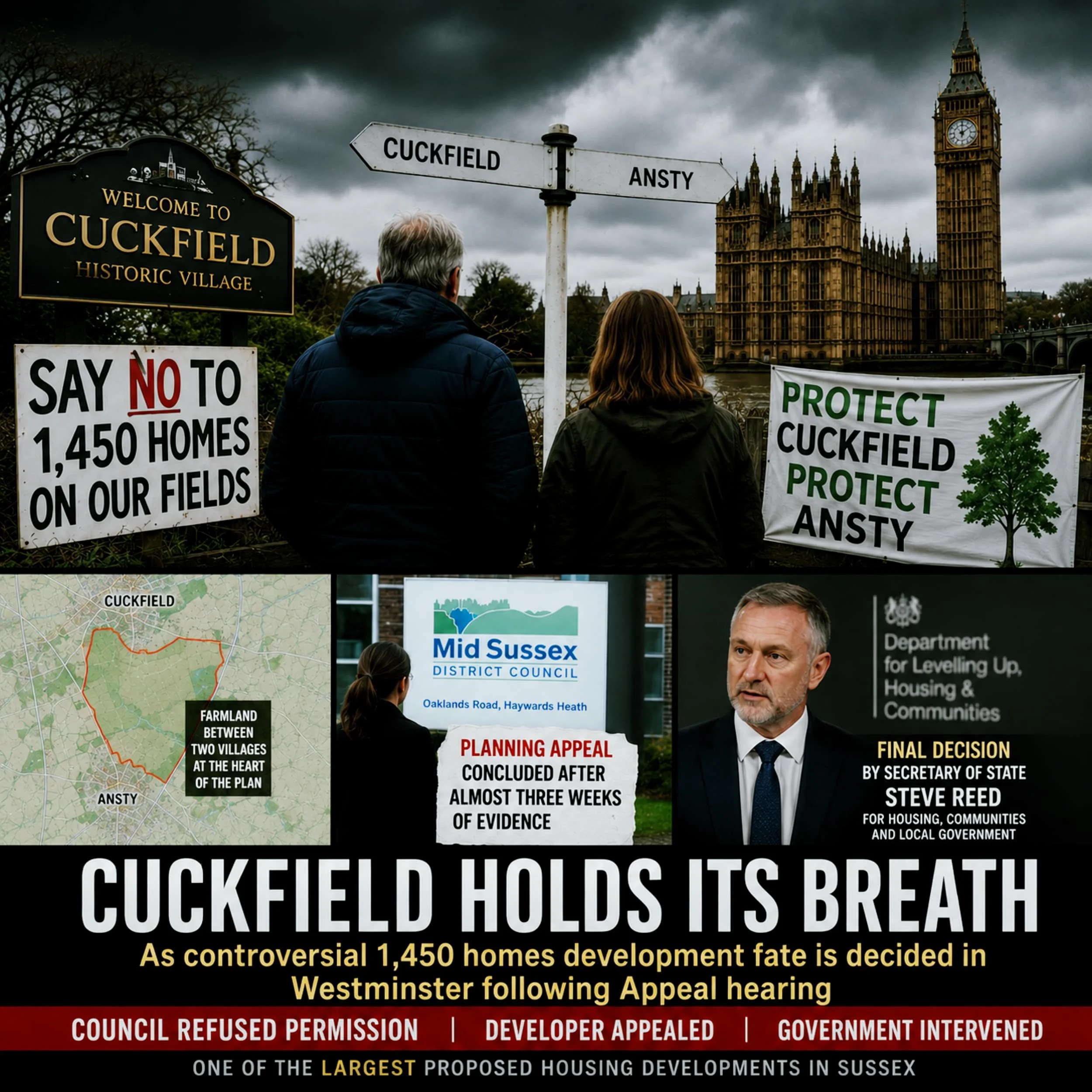
Cuckfield holds its breath, as well as fellow campaigners from neighbouring Ansty, as the fate of one of the South East's most controversial housing developments is decided in Westminster.
A planning appeal brought by developer Fairfax Acquisitions into proposals for 1,450 homes on farmland between the two villages, concluded this week. After almost three weeks of evidence at Mid Sussex District Council's headquarters in Haywards Heath, government-appointed Planning Inspector Joanna Gilbert will prepare her report and recommendation.
However, the final decision will be taken by the Secretary of State for Housing, Communities and Local Government, currently Steve Reed, after an intervention to recover the appeal during the third day of the inquiry.
Tension
That has heightened tension in Cuckfield, where many residents fear the Government could overturn the Council's original refusal of planning permission, as part of its drive to accelerate housebuilding following Labour's landslide General Election victory in 2024.
Fairfax appealed after Mid Sussex District Council refused outline planning permission in October 2025 for what would become one of the largest housing developments in Sussex.
Throughout the appeal, Fairfax argued the proposal represents the type of strategic development national planning policy now encourages in areas facing acute housing shortages.
In closing submissions, the developer's legal team claimed Mid Sussex cannot demonstrate a five-year supply of housing land, and said the district faces an urgent need for both market and affordable housing. It maintained that the benefits of delivering 1,450 homes, together with new community infrastructure and transport improvements, substantially outweigh any environmental harm.
‘Unlawful’
Fairfax also accused councillors of rejecting professional planning advice when refusing the application, and lodged a separate application seeking costs against the Council. Its legal team argued the authority had wrongly applied national planning policy when concluding that landscape impacts justified refusing permission.
Fairfax’s allegation that the Council had adopted an ‘unlawful’ approach to the National Planning Policy Framework, was vigorously rejected. In its closing statement, it argued the authority has one of the strongest records of housing delivery in England. Pointing to years of exceeding government housing targets before national planning policy changes dramatically increased the district's required housing numbers.
Committed
The Council insisted it has consistently planned positively for growth and remains committed to delivering thousands of additional homes through its emerging Local Plan. Rather than opposing development in principle, the Council argued this particular site is the wrong location.
It accepted that, with the proposed infrastructure package, secured through legal agreements, that concerns over schools, highways and local services had largely been addressed.
Unacceptable
It maintained, however, the development would still cause unacceptable harm to the countryside, separating Ansty and Cuckfield. It also claimed it would erode the setting of the High Weald National Landscape, resulting in the loss of more than 100 trees and fundamentally alter the rural character of the area.
The Council also argued that granting permission now would undermine work on its emerging Local Plan, which is currently examining alternative strategic housing sites capable of accommodating about 4,000 additional homes.
The two parish councils representing Cuckfield, and Ansty & Staplefield, reinforced those concerns in a separate submission. They described the appeal site as an "unspoilt rural landscape" whose medieval field patterns, ancient woodland and streams contribute to the distinctive character of the High Weald.
They argued the development would permanently ‘urbanise’ around 100 hectares of countryside and lead to the perceived coalescence of two historic villages that have remained physically separate for centuries.
Challenged
The parish councils also challenged the sustainability of the scheme, arguing that residents would remain heavily dependent on private cars despite proposed bus, walking and cycling improvements.
They questioned whether the proposed new bus service would ever become commercially viable once developer funding ended. They argued that if it failed, the development could not be regarded as a sustainable location under national planning policy.
Landscape formed one of the inquiry's most fiercely contested issues.
Fairfax maintained the scheme had been carefully designed to minimise impacts on the setting of the High Weald National Landscape through landscaping, woodland retention and sensitive design.
Opponents argued that, regardless of mitigation, a development of this scale, immediately adjoining the protected landscape, would inevitably damage its rural setting, dark skies and distinctive views.
The inquiry also strayed into a wider debate over Britain's planning system. Fairfax argued that the housing crisis requires substantial developments to come forward now rather than waiting for lengthy plan-making processes.
Undermine
The Council and Parish authorities countered that approving such a significant proposal outside the Local Plan process would undermine confidence in plan-led planning and potentially prejudice the selection of alternative sites.
The Secretary of State's decision to recover the appeal means the outcome will carry significance well beyond Mid Sussex. It comes as ministers seek to increase housebuilding across England as local authorities grapple with higher mandatory housing targets introduced under revised national planning policy.
Planning Inspector Ms Gilbert will now prepare her report after considering the evidence presented by all parties. Her conclusions will remain advisory. The final decision on whether Cuck-Stye becomes one of Sussex's largest new housing developments will ultimately be made in Westminster.
Whatever that decision, it is likely to become an important test of how the Government intends to balance its commitment to significantly increasing housing supply against local environmental protections. Alongside the principle that development should be guided through locally prepared plans.
Watch this space.